We Are Tasked to Know and Be Ourselves

Free Shot s
We are tasked in this time of great change and transition to learn exactly who we are – interdependent beings that are only as strong and healthy as the life-forms and raw materials are that surround them. As we witness all around us and throughout the world the wholesale destruction and pillaging of the “natural capitol” of the planet – the once thriving and abundant biodiversity in places untouched by modern acts of human exploitation and extraction – we respond in a variety of ways to halt this process of self-immolation and suicide from actually terminally taking place. But at the same time we recognize that fighting against a system gone mad does a great deal to reinforce that madness, and makes the maniacs bent on filling their pockets because they can and have been taught to do so, come up with all sorts of new and innovative ways of wreaking havoc on their surroundings for the shortsighted benefit of “themselves”.

If these madmen, who are really just suffering from a spell of amnesia, were to have an experience of their interconnected nature, perhaps in the depths of a sweat-lodge or around an ayahuasca ingesting circle of initiates, then perhaps they would think twice before ransoming off their “humanity” and “gaianity” for the sake of stoking their bank accounts. When it comes down to it, it doesn’t take much for a human or another being to be happy and fit. All we need is a bit of food in our bellies, and a bit of wilderness to roam in, and the company and community of our friends and families. It really is quite simple… and yet we have been taught to believe that only through an endless grabbing for more and bigger toys can we be happy. This all arises from the initial dilemma from the lie that is taught – that we are irretrievably removed from each other and the natural world.

Just look at the act of breathing to have this lie revoked. The natural world floods into us with every in-breath, becoming us down to the cellular level. Then we exhale, a bit of ourselves and our cells entering into and becoming the natural world once more. We are locked into and forever bound in a dance of interdependence, whether we like it or not. Here and now we are challenged to let go of our infantile rebellion to the connection with everything that is, was and will be, and come back to the circle of life after the tantrum that we have been so extravagantly throwing. Yes please, it is time to come back to life now.

– Joseph Stodgel 1/14/14

Seeing Through Scripture to The Sacred Mountain

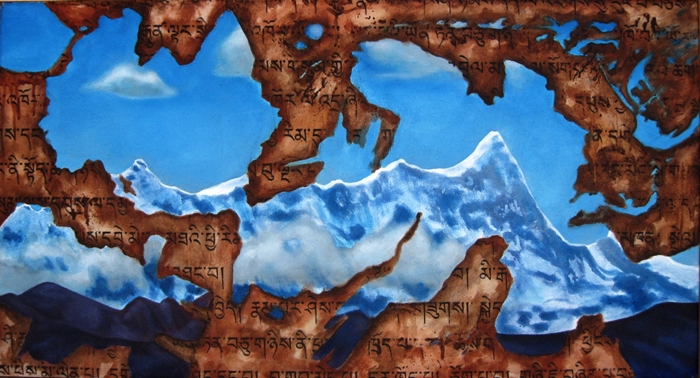
namcha barwa sI completed this painting as a student at University of Hawaii Manoa under the benevolent guidance of a painting teacher of mine there, Mr Jason Willome. During that time I was living up valley and would spend many afternoons sitting in a coffee shop drinking chai, eating homemade manna breads and reading The Heart of The World by Ian Baker. Many sittings I enjoyed with the thick book (just over 400 pages), and with every turned page grew more enthralled in the exploration and adventure as I followed the author on his great pilgrimage deep into the mysteries of Ancient Tibet. His journeys had led him to the foothills of Namcha Barwa, one of the tallest mountains in the world and the termination point of the Far Eastern flank of the Himalayan range.

Namcha Barwa Beginnings sUnderneath that mountain the Tsangpo Gorge, deepest in the world, plunges four times deeper than our beloved Grand Canyon here in the USA. The legend contained in scriptures had it that a great waterfall exists there in the thick of the rhododendrons and mired chasms. Ian Baker set out to find it, and the book encapsulates and recounts his absolutely epic journey over many years in doing so. After I read it, I set out to portray the story in a painted fashion, and this piece was the result of that effort. I used a variety of techniques to achieve something akin to looking through torn scripture at the colossal landscape, and above you can see how I started with selective priming then continued with a series of washes and finally an inkjet transfer of Tibetan Script.

The piece was featured in Lotus Space’s video series entitled Inpo: The Art of Invisibility, which was broadcast on Hawaii public television. It is my sincere hope that I can one day visit the gorge and see the great Namcha Barwa. May all beings be in bliss. Om Mani Padme Hum.

Into The Forest: Book Review

Last night I finished the book Into the Forest, written by Jean Hegland. She just so happens to dwell in the same patch of redwoods that I do, so I of course found the book especially relevant to my place and situation. I started the book months ago, read the first 15 pages and set it down for a while, only to pick it up only two days ago and read the rest within that time (it is a page turner).

The story is about two young girls coming of age in a time of great transition and turning. It takes place for the most part in their rural home far up in the woods and in the forest beyond where they slowly but surely lose their connection with the outside world. Economic upheaval, environmental collapse, and the dwindling of easy energy resources has devastated the United States and made it a hollow shell of what it once was. The government is broke and collapses, and the electricity or phone calls that once could reach the family become less and less until one day there is no more whatsoever.

Just as all of this is happening, the girls lose their Mother to cancer, and their Father slips into a sadness that they have never before witnessed. The three of them carry on, making weekly trips to the nearest town while the gas remains purchasable at the station. They expect the electricity to come back at some point; for life to return to normal once more so that one of the girls can get into Harvard and the other into a prestigious ballet company in San Francisco. One week as the three are on their way back from town, their father alerts them that they won’t be going back for some time, as there hasn’t been gas available to fill their truck on the last two visits.

Their next trip, months later, is shocking. Their nearest neighbor’s house has been abandoned and raided; the roads have started to deteriorate and have been partially overtaken with tall weeds; their vehicle is the only one on the road driving around, while countless others it seems are parked for good. Old friends in town have been replaced with gun wielding strangers, and the Father’s former place of work at the local school has been boarded up and shut down like countless other buildings. They attempt to gather some news and figure out what exactly is going on, but have only enough gas in their tank to get some supplies (all that is left at a nearly cleaned out abandoned-looking department store) and head back to their house in the hills on the edge of the forest.

In the months following, the three of them drag on with the heaviness of the situation and the burden of the loss of their mother and wife, and do their best to prepare for the coming winter with food rationing and canning missions to preserve the bounty of their garden and orchard. Shortly after, another tragedy befalls the girls and the two of them are left alone to fully take care of themselves.

Depression, hardship and some harrowing encounters with people who visit their land follow as they do their best to remain fed, healthy, and sane. In the end, they grow closer and closer to the forest that surrounds them – the forest that they were once taught to fear, and not go too near. All that they relied on as a comfort, support and necessity of modern humanity eventually fails them, becomes a burden and must be left aside lest it pull them under to sure detriment and death. The wildness and intelligence of the forest speaks to them and through them, until they know with a felt certainty that only there can they be held. Only there can they be home.

I greatly enjoyed this book, and especially so because it took me by surprise in the ways that it made me feel. The characters are brilliantly portrayed and easy to relate to as their journey became mine, as the reader. I was there with them as they watched their lives and society crumble all around them, for I too expect that this may be the future for our country. I was there with them as they dealt with the losses of those leaders who could show them a way out of the dark times and offer them protection and wisdom. I felt acutely their fear of not having enough food to eat, or water to drink, or gas to run the car to drive and escape from the wreckage that had become their lives.

I felt the frenzied craze as I have before of the survivalist movement. It coursed through me, leaving me wanting at once to figure things out; to install solar panels, buy a gun, establish food caches, amass resources and secure myself and family a stronghold in the boonies where the descending insanity of a world gone mad would not reach us. The author did not let me stop there though. She took me through to a simple truth and realization – that all these objects amassed and things to be acquired do not necessarily secure us with the certainty of life; that it is only us in our connection with each other and all that is living that can do so.

For the two girls in Into The Forest it all came down to the love that they shared, and how far they were willing to stay in that love with each other. It also came down to their willingness to engage with a being much larger than themselves – a whole breathing forest full of so much life, and with that so much potential help and support. There in the living forest, beyond the confines of the crumbling walls of their “fugue state” structures at the end of the road, they eventually found everything that they needed to not only live, but to be alive with something so much greater than they had ever known.

Read the book! http://www.jeanhegland.com/books/into-forest/

– Joseph Stodgel, 1/5/14
Stuff a Revolution

stuff a revolution2 s

Behold, the humble eco-brick – a plastic bottle stuffed with all things non-biodegradable. Whilst the so-called revolutionaries burn tires, break things and produce massive mountains of smoking trash, hard-at-work others stuff the dread and wastage of the industrial machine into little bottles and build places of council and learning with them. This revolution is not fought with burning molotov cocktails poised for destruction, but plastic bottles eating trash in an act of simple implosion that brings together the disintegrated synthetics and threads of an unraveling global supply chain.

What do you put forth into the world?

trashtotreasurefest.org

Mr. Solo Zozo on Display at Zozofest August 30 and 31

Solo Zozo s

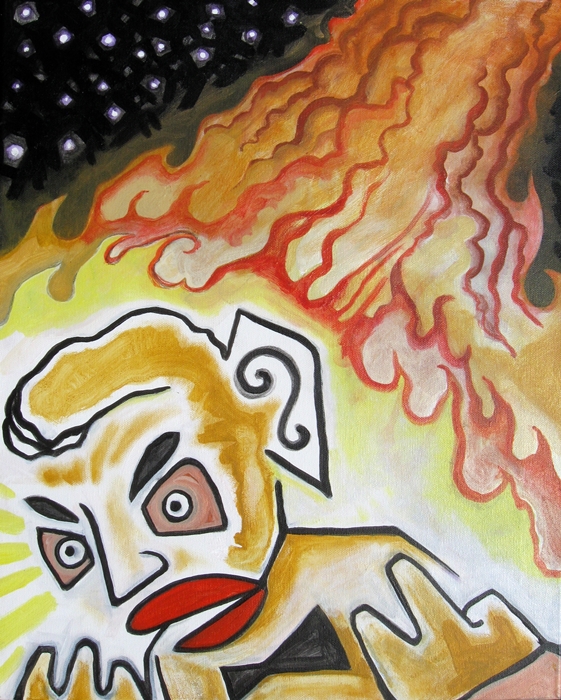
I made this piece of Zozobra in the last few days. He is a man on fire, a man set apart and filled with all of the feelings that people would rather not feel – especially fear and it’s manifestation as worry. I can see many emotions in this captured frame of Zozobra’s experience as a solo burner, a New Mexican Jesus crucified and burning for the sins of the masses. Fear must be a sin (not that I am one for harping on about sins) in that it disconnects us from the current experience of what is real around us, and leads to things such as imprisonments and crucifixions of innocent men and women.

I name this Mr. Solo Zozo as well with a certain influence coming from KiD CuDi who amongst other names refers to himself as Mr. Solo Dolo. His cover of his newest album, Indicud, is engulfed in flames, just like Zozobra. I have been listening to his music a fair amount whilst painting lately, and he himself seems like a Zozobra of sorts – speaking out about his depressions and sadness much more than the average lyricist. Burn him?

This painting will be on display along with one or two others in the works at the Annual Zozofest Art Show at El Museo Cultural in the Railyard of Santa Fe on the 30th and 31st of August. See the event page here: http://burnzozobra.com/zozofest/