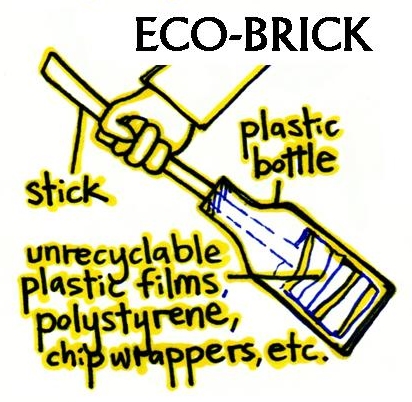
 This is one of the drawings that I have made for the new eco-brick instructions that I am developing for all sorts of applications from business cards and stickers to social media and blogging. Below is the tentative t-shirt design which is available as one of the perks on my ongoing Crowdfunding Campaign to raise money for the Sustainable Cup Challenge DO School Fellowship in NYC. I intend to develop at least a couple more designs and give people the option to pick from a few.
 If you would like to learn more about eco-bricks then check out the good work of Pura Vida Atitlan, Hug It Forward, and Ecobricks.org and read further below an excerpt from my Schumacher College MSc dissertation. Here is a bit of writing that I published about a year ago: “Behold, the humble eco-brick – a plastic bottle stuffed with all things non-biodegradable. Whilst the so-called revolutionaries burn tires, break things and produce massive mountains of smoking trash, hard-at-work others stuff the dread and wastage of the industrial machine into little bottles and build places of council and learning with them. This revolution is not fought with burning molotov cocktails poised for destruction, but plastic bottles eating trash in an act of simple implosion that brings together the disintegrated synthetics and threads of an unraveling global supply chain.What do you put forth into the world?”
 “A better method of containing the non-biodegradable waste stream is available, and to be found in the simple plastic bottle of which there is no end in sight. They are designed to be containment vessels, so it probably best that we use them as such.[1] This idea brings us to the eco-brick and the work of Pura Vida Atitlan of Guatemala and the other organizations and individuals worldwide who are stuffing their plastic waste streams into bottle bricks, preventing it all from wrecking pollution on their homes and utilizing the otherwise nocicycled† materials as beneficial building components. Certain groups have even gone to the extent of turning the trash of entire landfills into schools they couldn’t otherwise afford.[2]
My first encounter with the act of filling plastic bottles with trash took place many years ago on a backpacking trip in the Sangre De Christo mountain range outside of my hometown of Santa Fe, New Mexico. As we agreed with and were following Leave No Trace principles and practice to the best of our abilities, we were collecting all of our trash produced in a black sack that swelled to a substantial size. Wanting to save on space and do something around the fire, my friend John Armstrong began to stuff the whole lot of the trash into a one-liter sports drink bottle that we had. Instead of walking out with a substantially sized black trash sack full of trash, we walked out with a hardened bottle compressed to the brim.
 Rediscovering this lost art of upcycling and considering it’s potential in building projects came to me just days before I departed to South Africa to conduct my dissertation research. I was excited to say the least at having found a simple solution to the question of what to do with “the rest of the stuff”. I was back in the area of Schumacher College and picked up the most recent copy of Resurgence where I quickly found an article by the environmentalist Nicola Peel whom I met last year at the College. I read of her work helping to clean up villages by spreading the simple wisdom of Pura Vida Atitlan, who have overseen and encouraged the creation of thousands upon thousands of plastic bottle bricks stuffed with all sorts of plastic trash to make walls, garden partitions, schools, and health centres for much cheaper than otherwise and of great benefit in the beautification of surrounding areas. [3] On PVA’s site I was awe-struck and inspired to find shot after shot of upcycled buildings going up and all of the smiling and stoked faces of the local people involved. I recognized quite quickly that this was the direction that I wanted to take the work in South Africa, and was deeply gladdened to have such an example to work from. It is home-made upcycling par excellence.” *
† [“We can use the word nocicycling to refer to any and all forms of waste management which cause harm (the prefix noci- comes from the Latin nocere meaning ‘to harm’). Unfortunately, most all forms of modern and industrial waste management, including most recycling practices, are in one way or another harmful to human beings and other species.”*]
[1] Plastic bottles are the responsible elder siblings of the plastics family with arms big enough to hug and contain the rest of their unruly siblings.
[2] HUSK Cambodia, http://www.huskcambodia.org/
[3] Pura Vida Atitlan, http://puravidaatitlan.org/
* Extracted from pages 10 and 16-17 of Joseph Stodgel’s Schumacher College MSc Dissertation entitled Trash to Treasure: Making Rehabilitation a Celebration and Cultivating the Authentic Wholeness of Upcycling.


 LOVE TREE PRODUCTIONS